
Laughter is a universal human expression, a complex response with a wide range of nuances. To truly capture its essence in writing or speech, a rich vocabulary of adjectives is essential. This article provides a comprehensive exploration of adjectives that describe laughter, covering their meanings, usage, and subtle differences. Whether you are a student, writer, or simply someone looking to enhance your descriptive abilities, this guide will equip you with the tools to articulate the many facets of laughter.
Understanding these adjectives not only improves your writing and communication skills but also deepens your appreciation for the emotional landscape of human interaction. By mastering the art of describing laughter, you can bring your stories and conversations to life, making them more vivid and engaging.
Table of Contents
- Definition: Adjectives for Laughter
- Structural Breakdown
- Types of Laughter and Corresponding Adjectives
- Examples of Adjectives Describing Laughter
- Usage Rules for Adjectives Describing Laughter
- Common Mistakes When Using Adjectives for Laughter
- Practice Exercises
- Advanced Topics: Nuances and Connotations
- Frequently Asked Questions
- Conclusion
Definition: Adjectives for Laughter
Adjectives for laughter are descriptive words used to characterize the qualities, nature, or manner of laughter. They provide specific details about how laughter sounds, feels, or appears, adding depth and color to descriptions. These adjectives help to convey the emotional context and intentions behind the laughter, allowing the audience to better understand the situation and the characters involved.
Adjectives modifying laughter fall into several categories, including those describing the volume (e.g., loud, soft, deafening), tone (e.g., joyful, bitter, mocking), physical characteristics (e.g., wheezing, gasping, uncontrollable), and emotional impact (e.g., infectious, hollow, forced). Each adjective reveals a specific aspect of the laughter, providing a more complete and nuanced portrayal.
The correct choice of adjective depends heavily on the context. For instance, hearty laughter suggests genuine joy and enthusiasm, while forced laughter indicates insincerity or discomfort. A writer’s ability to select the most appropriate adjective is crucial for effective communication and storytelling. Understanding the connotations and implications of each adjective is key to using them effectively.
Structural Breakdown
The structure of using adjectives to describe laughter is relatively straightforward. Typically, the adjective precedes the noun “laughter.” However, adjectives can also be used after linking verbs (such as “is,” “seems,” “appears”) to describe the laughter.
Here are the common structures:
- Adjective + Laughter: This is the most common structure. Example: A boisterous laughter filled the room.
- Laughter + Linking Verb + Adjective: This structure is used to describe the laughter as a characteristic. Example: Her laughter was infectious.
- Adverb + Adjective + Laughter: Adverbs can be used to further modify the adjective, adding another layer of detail. Example: A genuinely heartwarming laughter echoed through the halls.
Understanding these structures allows for flexibility in writing and ensures that the descriptive language flows naturally. The choice of structure often depends on the writer’s style and the desired emphasis.
Types of Laughter and Corresponding Adjectives
Laughter is not a monolithic phenomenon; it manifests in various forms, each with its own characteristics and underlying emotions. Understanding these different types of laughter is crucial for selecting the most appropriate adjective.
Joyful Laughter
Joyful laughter is characterized by genuine happiness and amusement. It is often spontaneous and unrestrained, reflecting a positive emotional state.
Adjectives for joyful laughter include: hearty, gleeful, boisterous, merry, infectious, delighted, euphoric, jovial, lighthearted, cheerful, radiant, exuberant, rollicking, sunny, and blissful.
Nervous Laughter
Nervous laughter arises from anxiety, discomfort, or awkwardness. It is often used as a coping mechanism in stressful situations.
Adjectives for nervous laughter include: forced, strained, jittery, uncomfortable, anxious, hesitant, restrained, weak, high-pitched, fidgety, suppressed, artificial, self-conscious, and tittering.
Sarcastic Laughter
Sarcastic laughter is used to mock or express contempt. It is often tinged with cynicism and irony.
Adjectives for sarcastic laughter include: mocking, scornful, cynical, derisive, ironic, bitter, contemptuous, sneering, taunting, sardonic, dismissive, wry, cutting, and acidic.
Cruel Laughter
Cruel laughter is intended to inflict pain or humiliate others. It is malicious and often associated with bullying or social exclusion.
Adjectives for cruel laughter include: vindictive, malicious, heartless, brutal, callous, ruthless, vicious, savage, merciless, bullying, derogatory, insensitive, oppressive, and degrading.
Subtle Laughter
Subtle laughter is understated and discreet. It may involve quiet chuckles or barely perceptible smiles.
Adjectives for subtle laughter include: quiet, gentle, soft, muted, restrained, low, slight, understated, suppressed, private, inward, contained, imperceptible, and almost silent.
Examples of Adjectives Describing Laughter
To further illustrate the use of adjectives for laughter, here are several examples categorized by the type of laughter they describe. These examples demonstrate how different adjectives can evoke distinct emotions and paint vivid pictures.
Joyful Laughter Examples
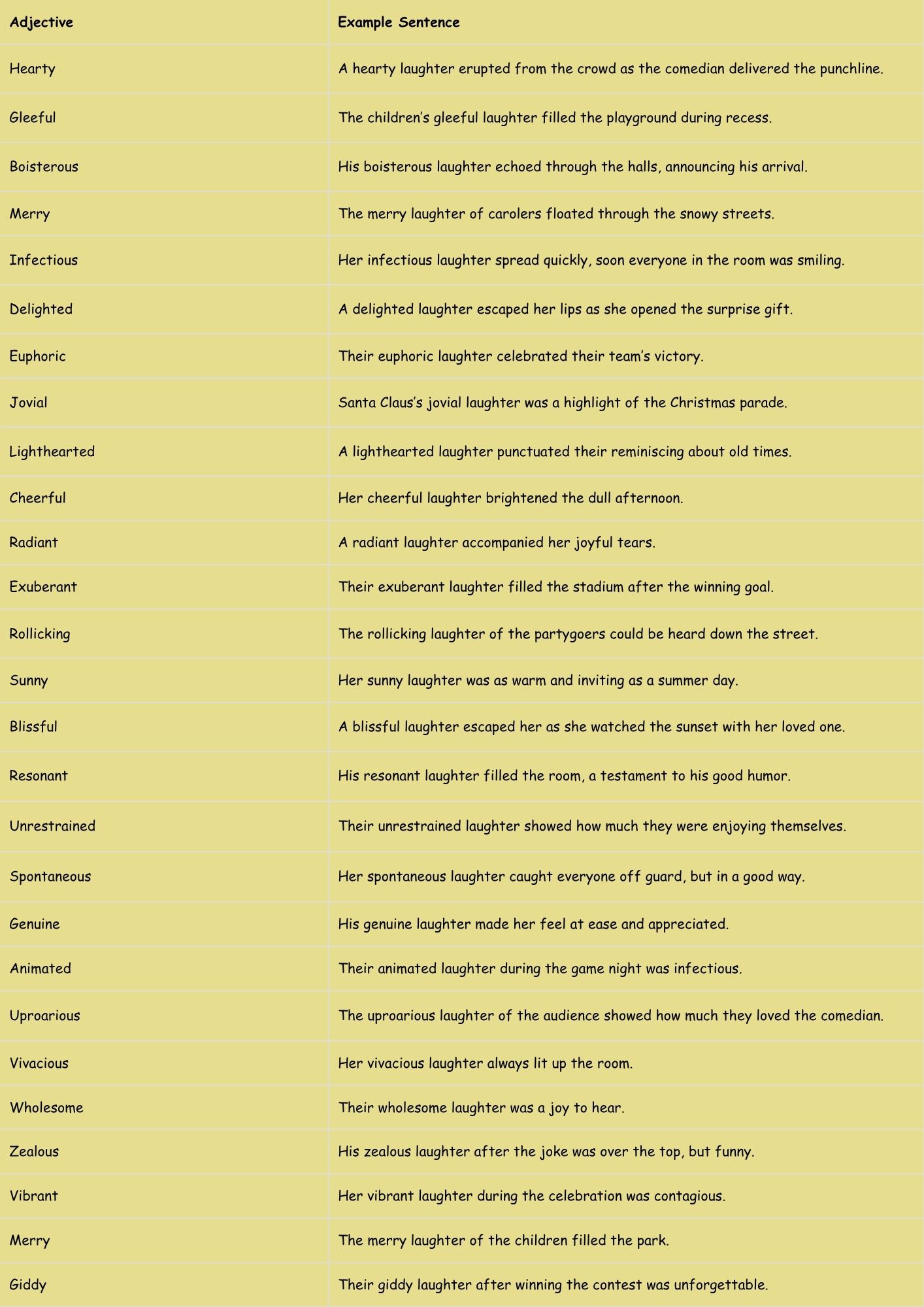
The following table provides examples of adjectives used to describe joyful laughter in various contexts. Each example aims to showcase the specific nuance that the adjective brings to the description of laughter.
| Adjective | Example Sentence |
|---|---|
| Hearty | A hearty laughter erupted from the crowd as the comedian delivered the punchline. |
| Gleeful | The children’s gleeful laughter filled the playground during recess. |
| Boisterous | His boisterous laughter echoed through the halls, announcing his arrival. |
| Merry | The merry laughter of carolers floated through the snowy streets. |
| Infectious | Her infectious laughter spread quickly, soon everyone in the room was smiling. |
| Delighted | A delighted laughter escaped her lips as she opened the surprise gift. |
| Euphoric | Their euphoric laughter celebrated their team’s victory. |
| Jovial | Santa Claus’s jovial laughter was a highlight of the Christmas parade. |
| Lighthearted | A lighthearted laughter punctuated their reminiscing about old times. |
| Cheerful | Her cheerful laughter brightened the dull afternoon. |
| Radiant | A radiant laughter accompanied her joyful tears. |
| Exuberant | Their exuberant laughter filled the stadium after the winning goal. |
| Rollicking | The rollicking laughter of the partygoers could be heard down the street. |
| Sunny | Her sunny laughter was as warm and inviting as a summer day. |
| Blissful | A blissful laughter escaped her as she watched the sunset with her loved one. |
| Resonant | His resonant laughter filled the room, a testament to his good humor. |
| Unrestrained | Their unrestrained laughter showed how much they were enjoying themselves. |
| Spontaneous | Her spontaneous laughter caught everyone off guard, but in a good way. |
| Genuine | His genuine laughter made her feel at ease and appreciated. |
| Animated | Their animated laughter during the game night was infectious. |
| Uproarious | The uproarious laughter of the audience showed how much they loved the comedian. |
| Vivacious | Her vivacious laughter always lit up the room. |
| Wholesome | Their wholesome laughter was a joy to hear. |
| Zealous | His zealous laughter after the joke was over the top, but funny. |
| Vibrant | Her vibrant laughter during the celebration was contagious. |
| Merry | The merry laughter of the children filled the park. |
| Giddy | Their giddy laughter after winning the contest was unforgettable. |
Nervous Laughter Examples
This table showcases how adjectives can depict nervous laughter, highlighting the tension and discomfort associated with it.
| Adjective | Example Sentence |
|---|---|
| Forced | A forced laughter escaped him as he tried to defuse the awkward situation. |
| Strained | Her strained laughter revealed her underlying anxiety. |
| Jittery | A jittery laughter punctuated his nervous speech. |
| Uncomfortable | An uncomfortable laughter rippled through the audience after the embarrassing joke. |
| Anxious | His anxious laughter betrayed his true feelings about the upcoming test. |
| Hesitant | A hesitant laughter followed her uncertain response. |
| Restrained | Her restrained laughter indicated she was trying to maintain composure. |
| Weak | A weak laughter was his only response to the tense conversation. |
| High-pitched | Her high-pitched laughter was a clear sign of her nervousness. |
| Fidgety | A fidgety laughter accompanied his restless movements. |
| Suppressed | A suppressed laughter bubbled up as she tried to remain serious. |
| Artificial | His artificial laughter sounded insincere and unsettling. |
| Self-conscious | A self-conscious laughter followed her clumsy remark. |
| Tittering | Their tittering laughter suggested they were trying to stifle their amusement. |
| Uncertain | An uncertain laughter met his unexpected proposal. |
| Uneasy | An uneasy laughter was a telling sign of her nervousness. |
| Edgy | His edgy laughter indicated his discomfort with the topic. |
| Timid | Her timid laughter showed her fear of speaking out. |
| Guarded | His guarded laughter revealed he wasn’t entirely comfortable. |
| Faint | A faint laughter was all she could manage in her state of anxiety. |
| Weakened | Her weakened laughter showed how much the situation had drained her. |
| Tremulous | His tremulous laughter betrayed his fear of the unknown. |
| Stifled | Her stifled laughter showed how hard she was trying to remain calm. |
| Hollow | His hollow laughter revealed the depth of his anxiety. |
| Thin | A thin laughter followed his attempt at a joke. |
Sarcastic Laughter Examples
This table provides examples of how adjectives can effectively portray sarcastic laughter, highlighting its mocking and cynical nature.
| Adjective | Example Sentence |
|---|---|
| Mocking | A mocking laughter greeted his sincere attempt to apologize. |
| Scornful | Her scornful laughter conveyed her utter contempt for his ideas. |
| Cynical | A cynical laughter was his response to the politician’s empty promises. |
| Derisive | Their derisive laughter echoed as he stumbled on stage. |
| Ironic | An ironic laughter followed his claim of being completely unbiased. |
| Bitter | A bitter laughter escaped her as she recounted her past failures. |
| Contemptuous | His contemptuous laughter made it clear he had no respect for her opinions. |
| Sneering | A sneering laughter accompanied his insulting remarks. |
| Taunting | Their taunting laughter was intended to provoke him into a fight. |
| Sardonic | His sardonic laughter revealed a deep-seated resentment. |
| Dismissive | A dismissive laughter brushed aside her concerns. |
| Wry | A wry laughter followed her self-deprecating joke. |
| Cutting | His cutting laughter was designed to wound her pride. |
| Acidic | An acidic laughter dripped with sarcasm and hostility. |
| Sarcastic | Her sarcastic laughter was a defense mechanism. |
| Mock | His mock laughter was meant to belittle her achievements. |
| Contrived | Their contrived laughter was clearly insincere. |
| Disdainful | Her disdainful laughter showed her lack of respect. |
| Ironic | His ironic laughter was a way of masking his hurt. |
| Caustic | Her caustic laughter was as sharp as a knife. |
| Cynical | His cynical laughter revealed a deep-seated pessimism. |
| Skeptical | Her skeptical laughter showed that she didn’t believe him. |
| Derogatory | Their derogatory laughter was an attempt to humiliate her. |
| Snide | His snide laughter was a clear sign of his jealousy. |
| Acerbic | Her acerbic laughter was as bitter as gall. |
Cruel Laughter Examples
The following table provides examples of adjectives used to describe cruel laughter, emphasizing its malicious and harmful nature.
| Adjective | Example Sentence |
|---|---|
| Vindictive | A vindictive laughter celebrated his opponent’s downfall. |
| Malicious | Their malicious laughter was intended to inflict emotional pain. |
| Heartless | A heartless laughter greeted the news of the tragedy. |
| Brutal | His brutal laughter was a display of pure cruelty. |
| Callous | Their callous laughter showed a complete lack of empathy. |
| Ruthless | A ruthless laughter accompanied his merciless actions. |
| Vicious | Their vicious laughter was a form of psychological abuse. |
| Savage | A savage laughter erupted as the victim was publicly humiliated. |
| Merciless | His merciless laughter echoed in the empty room. |
| Bullying | Their bullying laughter was a common occurrence in the schoolyard. |
| Derogatory | A derogatory laughter followed her every mistake. |
| Insensitive | Their insensitive laughter revealed a profound lack of understanding. |
| Oppressive | An oppressive laughter hung heavy in the air, creating a climate of fear. |
| Degrading | Their degrading laughter was a deliberate attempt to strip her of her dignity. |
| Spiteful | His spiteful laughter showed his desire to harm her. |
| Barbaric | Their barbaric laughter was a sign of their inhumanity. |
| Inhumane | His inhumane laughter was chilling to hear. |
| Sadistic | Their sadistic laughter revealed their pleasure in others’ suffering. |
| Vile | His vile laughter was a reflection of his evil nature. |
| Mean-spirited | Their mean-spirited laughter was aimed at making her feel small. |
| Depraved | His depraved laughter was a sign of his moral corruption. |
| Malevolent | Their malevolent laughter filled the room with dread. |
| Brutish | His brutish laughter was as crude as his behavior. |
| Sardonic | Their sardonic laughter was a way of mocking his misfortunes. |
| Mocking | His mocking laughter wounded her more than any insult. |
Subtle Laughter Examples
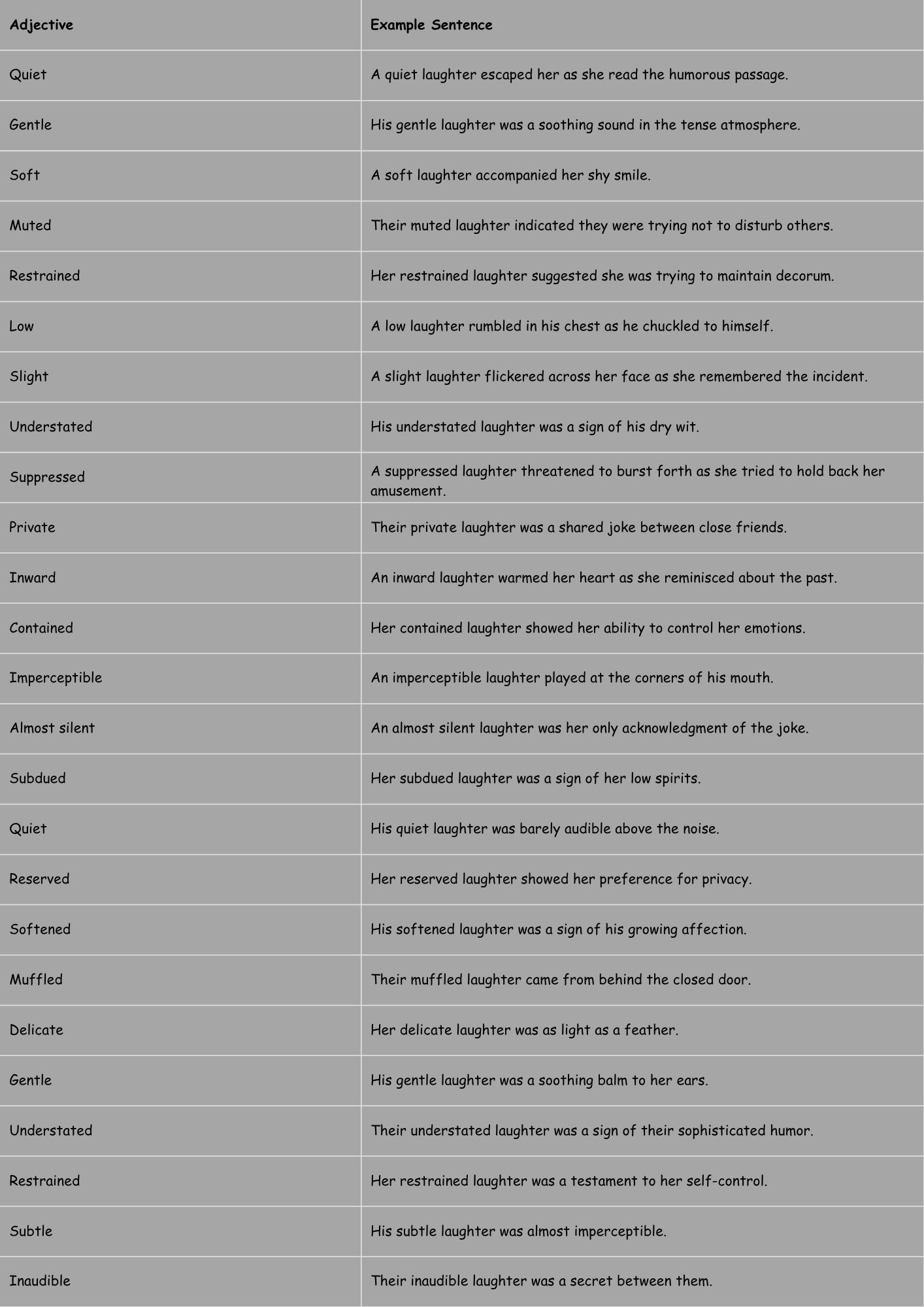
This table demonstrates the use of adjectives to describe subtle laughter, highlighting its quiet and understated nature.
| Adjective | Example Sentence |
|---|---|
| Quiet | A quiet laughter escaped her as she read the humorous passage. |
| Gentle | His gentle laughter was a soothing sound in the tense atmosphere. |
| Soft | A soft laughter accompanied her shy smile. |
| Muted | Their muted laughter indicated they were trying not to disturb others. |
| Restrained | Her restrained laughter suggested she was trying to maintain decorum. |
| Low | A low laughter rumbled in his chest as he chuckled to himself. |
| Slight | A slight laughter flickered across her face as she remembered the incident. |
| Understated | His understated laughter was a sign of his dry wit. |
| Suppressed | A suppressed laughter threatened to burst forth as she tried to hold back her amusement. |
| Private | Their private laughter was a shared joke between close friends. |
| Inward | An inward laughter warmed her heart as she reminisced about the past. |
| Contained | Her contained laughter showed her ability to control her emotions. |
| Imperceptible | An imperceptible laughter played at the corners of his mouth. |
| Almost silent | An almost silent laughter was her only acknowledgment of the joke. |
| Subdued | Her subdued laughter was a sign of her low spirits. |
| Quiet | His quiet laughter was barely audible above the noise. |
| Reserved | Her reserved laughter showed her preference for privacy. |
| Softened | His softened laughter was a sign of his growing affection. |
| Muffled | Their muffled laughter came from behind the closed door. |
| Delicate | Her delicate laughter was as light as a feather. |
| Gentle | His gentle laughter was a soothing balm to her ears. |
| Understated | Their understated laughter was a sign of their sophisticated humor. |
| Restrained | Her restrained laughter was a testament to her self-control. |
| Subtle | His subtle laughter was almost imperceptible. |
| Inaudible | Their inaudible laughter was a secret between them. |
Usage Rules for Adjectives Describing Laughter
Using adjectives to describe laughter effectively requires adherence to certain grammatical rules and stylistic considerations. Here are some key guidelines:
- Placement: Adjectives typically precede the noun “laughter” (e.g., a hearty laughter). However, they can also follow a linking verb (e.g., her laughter was infectious).
- Agreement: Adjectives must agree in number with the noun they modify. Since “laughter” is typically uncountable, the adjective remains in its singular form.
- Context: The choice of adjective should align with the context of the sentence and the overall tone of the writing. Consider the emotional state of the character and the situation being described.
- Clarity: Select adjectives that are precise and unambiguous. Avoid vague or overly general terms that do not add meaningful detail.
- Variety: Use a variety of adjectives to avoid repetition and to create a more nuanced and engaging description. Explore synonyms and related terms to expand your vocabulary.
- Figurative Language: Adjectives can be used figuratively to create vivid imagery and evoke strong emotions. For example, “a chilling laughter” uses the adjective “chilling” to suggest fear or unease.
By following these usage rules, you can ensure that your descriptions of laughter are accurate, effective, and stylistically appropriate.
Common Mistakes When Using Adjectives for Laughter
Even experienced writers sometimes make mistakes when using adjectives to describe laughter. Here are some common errors to avoid:
| Incorrect | Correct | Explanation |
|---|---|---|
| A loudly laughter | A loud laughter | “Loudly” is an adverb, not an adjective. Use “loud” to describe the laughter. |
| Her laughter was happily | Her laughter was happy | “Happily” is an adverb. Use the adjective “happy” to describe the laughter. |
| A fun laughter | A joyful laughter | “Fun” is often used as an adjective, but “joyful” more accurately describes the type of laughter. |
| The laughter was sadly | The laughter was sad | “Sadly” is an adverb. Use the adjective “sad” to describe the laughter. |
| A good laughter | A hearty laughter | “Good” is too general. “Hearty” provides a more specific and vivid description. |
| The laughter was angerly | The laughter was angry | “Angerly” is an adverb. The correct adjective is “angry”. |
| A hardly laughter | A faint laughter | “Hardly” means “barely”. The adjective “faint” is more appropriate. |
| The laugh was fearly | The laughter was fearful | “Fearly” is not a word. The correct adjective is “fearful”. |
| A badly laughter | A forced laughter | “Badly” is an adverb. “Forced” describes the unnatural quality of the laughter. |
| The laughter was serious | There was no laughter | If the laughter is serious it is either sarcastic or it is not there. |
By being aware of these common mistakes, you can improve the accuracy and effectiveness of your writing.
Practice Exercises
Test your understanding of adjectives for laughter with these practice exercises. Choose the most appropriate adjective from the list to complete each sentence.
| Question | Adjective Choices | Answer |
|---|---|---|
| 1. A __________ laughter erupted from the audience as the clown tripped. | (a) nervous, (b) boisterous, (c) subtle | (b) boisterous |
| 2. Her __________ laughter revealed her discomfort with the situation. | (a) gleeful, (b) strained, (c) merry | (b) strained |
| 3. A __________ laughter greeted his attempt at a heartfelt apology. | (a) mocking, (b) joyful, (c) quiet | (a) mocking |
| 4. Their __________ laughter was intended to humiliate the new student. | (a) vindictive, (b) lighthearted, (c) gentle | (a) vindictive |
| 5. A __________ laughter escaped her as she read the funny text message. | (a) loud, (b) quiet, (c) forced | (b) quiet |
| 6. His __________ laughter was infectious, and soon everyone was laughing along. | (a) sarcastic, (b) hearty, (c) nervous | (b) hearty |
| 7. The comedian’s __________ laughter filled the theater with joy. | (a) subdued, (b) exuberant, (c) cynical | (b) exuberant |
| 8. A __________ laughter followed his awkward attempt at a joke. | (a) derisive, (b) subtle, (c) nervous | (c) nervous |
| 9. The villain’s __________ laughter sent shivers down their spines. | (a) merry, (b) malicious, (c) gentle | (b) malicious |
| 10. A __________ laughter could be heard from the library, quickly silenced by the librarian. | (a) restrained, (b) bullying, (c) boisterous | (a) restrained |
| 11. His __________ laughter showed that he was genuinely amused. | (a) forced, (b) gleeful, (c) derisive | (b) gleeful |
| 12. Her __________ laughter made it clear that she didn’t find the situation funny. | (a) sarcastic, (b) gentle, (c) hearty | (a) sarcastic |
| 13. The bully’s __________ laughter echoed through the playground. | (a) vindictive, (b) soft, (c) cheerful | (a) vindictive |
| 14. A __________ laughter escaped her lips as she watched the sunset. | (a) subtle, (b) forced, (c) mocking | (a) subtle |
| 15. His __________ laughter was a welcome sound after a long day. | (a) nervous, (b) hearty, (c) cruel | (b) hearty |
Advanced Topics: Nuances and Connotations
For advanced learners, understanding the subtle nuances and connotations of adjectives for laughter can significantly enhance their writing and communication skills. Some adjectives carry cultural or social implications that can affect their interpretation.
For example, the adjective “wicked” can describe laughter, but its meaning depends on the context. It can suggest mischievousness or a dark sense of humor. Similarly, the adjective “maniacal” implies uncontrolled and potentially dangerous laughter, often associated with madness or extreme excitement. The adjective “hollow” suggests emptiness or insincerity, implying a lack of genuine emotion behind the laughter.
Exploring the etymology of adjectives can also provide valuable insights into their meanings and usage. Understanding the historical roots of a word can reveal its original connotations and how its meaning has evolved over time.
Ultimately, mastering the art of describing laughter involves not only knowing the definitions of adjectives but also understanding their emotional impact and cultural significance. This requires careful observation, critical thinking, and a willingness to experiment with language.
Frequently Asked Questions
Here are some frequently asked questions about using adjectives for laughter:
- What is the difference between “loud” and “boisterous” laughter?While both adjectives describe the volume of laughter, “loud” simply indicates a high level of sound. “Boisterous” implies a more energetic and unrestrained quality, often associated with high spirits and enthusiasm.
- How can I avoid using clichés when describing laughter?To avoid clichés, focus on specific details and unique characteristics of the laughter. Instead of using generic adjectives like “happy” or “funny,” try more descriptive terms that capture the specific emotion or nuance you want to
convey. Consider the context, the person laughing, and the reason for their laughter. - Can an adjective describe more than one type of laughter?Yes, some adjectives can be used to describe multiple types of laughter, depending on the context. For example, “forced” can describe both nervous and sarcastic laughter. The specific meaning is determined by the situation and the intent behind the laughter.
- How do I choose the best adjective for laughter in my writing?To choose the best adjective, consider the specific qualities of the laughter you want to convey. Think about the volume, tone, emotional impact, and physical characteristics of the laughter. Use a thesaurus to explore synonyms and related terms, and select the adjective that most accurately captures the essence of the laughter.
- Is it okay to use multiple adjectives to describe laughter?Yes, using multiple adjectives can provide a richer and more detailed description of laughter. However, be mindful of using too many adjectives, as this can make your writing sound cluttered or unnatural. Choose adjectives that complement each other and add meaningful detail.
- What are some examples of adjectives that describe the quality or timbre of laughter?Adjectives like “raspy,” “melodious,” “shrill,” and “silvery” describe the sound quality or timbre of laughter. These adjectives convey the unique auditory characteristics of the laughter, adding another layer of detail to your description.
- How can I use adjectives to show the effect of laughter on others?Adjectives such as “infectious,” “disarming,” and “unnerving” can be used to describe the impact of laughter on others. These adjectives convey how the laughter affects the emotions and behavior of those who hear it.
Conclusion
Mastering the art of describing laughter through the effective use of adjectives is a valuable skill for anyone looking to enhance their writing and communication abilities. By understanding the nuances, connotations, and usage rules of various adjectives, you can bring your stories and conversations to life, making them more vivid, engaging, and emotionally resonant. Whether you are describing joyful, nervous, sarcastic, cruel, or subtle laughter, the right adjective can make all the difference in conveying the true essence of this complex and universal human expression. Embrace the power of descriptive language, and let your words paint a thousand pictures.